Owner help
Your BDA failed its annual test. Here is the plan.
Get the full written report, then ask a qualified vendor to sort each item into maintenance (no permit) or a change to the system (permit and radio license holder consent). Fix the urgent items first, especially battery and oscillation problems, then have the failed parts re-tested and send the new report to the fire code official (IFC 2021 510.3, 510.6.1). Tell the fire department your repair date early, and keep everything in writing.
Step 1: Read the report, not just the result
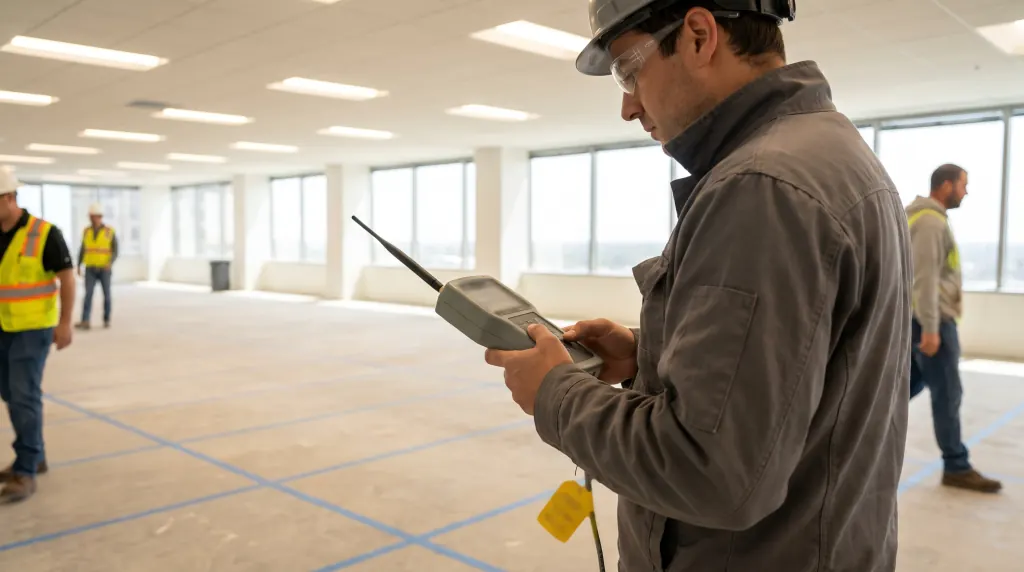
Ask the tester for the full written report, not a one-line pass or fail. It should show the grid results for each floor, the gain readings against the acceptance values, the battery test and any notes on oscillation. Those are the parts of the annual test the model code lists (IFC 2021 510.6.1).
Then sort the deficiency list into three groups:
- Safety now. Battery that could not carry the load, oscillation, donor antenna failure, a system that is down. These come first.
- Coverage. Floors or critical areas such as stairwells and elevator lobbies that fell short. A floor fails when more than one of its 20 test areas fails, with one re-divided retest allowed when exactly two fail (IFC 2021 510.5.4).
- Paperwork. Missing acceptance gain values, missing consent letter, missing FCC registration. These are real failures too: if the gain values are lost, the owner can be required to rerun the acceptance test (IFC 2021 510.5.4 item 6).
Step 2: Find the cause
Most failures trace back to something that changed: an aging battery, a donor antenna moved by roof work, renovations that block signal, or a change to the public safety radio system. Our page on common BDA failures explains each one and what the code checks. Use it to ask your vendor good questions; this page is about what you, the owner, do next.
Step 3: Repair or upgrade?
| What failed | Usually | Permit? | Radio license holder consent? |
|---|---|---|---|
| Battery or charger | Repair: replace with the same type | Usually no, it is maintenance (IFC 2021 510.3) | Usually no |
| Gain drift, settings | Repair: retune and document new settings | Ask your fire marshal | Ask the vendor; Florida requires it for any modification |
| Oscillation | Repair: restore antenna isolation, adjust gain | Depends on the scope | If antennas or gain change, likely yes |
| A few failed grid areas | Upgrade: add or move indoor antennas | Yes, it modifies the system (IFC 2021 510.3) | Yes (F.S. 633.202(18)(d)) |
| Radio system changed frequencies | Upgrade: modify or expand the system at the owner's expense (IFC 2021 510.6.2) | Yes | Yes |
| Amplifier failed, end of life | Replace, sometimes with a newer model | Yes if it modifies the system | Yes |
Two rules sit behind the last two columns. The FCC lets a building operate a booster on public safety channels only with the express consent of the radio license holder (47 CFR 90.219(b)(1)(i)). Florida adds that "any modification to an existing system or any installation of a new system must have the express consent of the frequency licenseholder" (F.S. 633.202(18)(d)). The code also requires coverage to meet the general area and critical area numbers after the work, not before (IFC 2021 510.4.1).
Step 4: Get comparable quotes
Send every vendor the same packet:
- The full test report with floor grids.
- The acceptance test report and gain values, if you have them.
- Any notice or deadline from the fire department.
- A list of renovations since the system was accepted.
Ask each one: which deficiency items their price fixes, whether the work counts as maintenance or a modification, whether the price includes the permit and the license holder's consent, and what the re-test costs. Prices are covered on our BDA cost page.
Step 5: Re-test
When the work is done, the affected parts are tested again. Under the model code, testing is required where changes could materially change the original field performance tests (IFC 2021 510.6.1), so new antennas usually mean a new grid test on those floors. Ask your fire marshal what the re-test must cover.
Plan for access on re-test day. Fire departments can charge for re-inspections. Miami-Dade, for example, charges $98.46 for the first or second re-inspection of a fire safety system and $194.44 for a third or later one (Implementing Order 04-123).
Step 6: Tell the fire department
The test report goes to the fire code official (IFC 2021 510.6.1). If yours failed, the fire department will see that. Call the fire prevention office and tell them:
- what failed and what you are doing about it;
- the vendor you hired and the repair date;
- when the re-test is booked.
If you receive a formal notice, read the deadline on it. In Florida, a fire marshal requiring an existing building to retrofit after the statewide dates must give at least one year from the notice of code violation (F.S. 633.202(18)(g)). Local rules for your city or county are on ERRCSCheck.
A realistic timeline
| Stage | What happens |
|---|---|
| Week 1 | Get the full report, sort the list, call the fire department |
| Weeks 1 to 3 | Collect quotes on the same scope; board or owner approval |
| Before work starts | Permit and license holder consent, if the work is a modification |
| Repair | Battery and settings work is often quick; antenna work takes longer |
| Re-test | Affected floors or the whole system, as the fire marshal requires |
| After | Send the new report and log the date in a free reminder |
We do not print typical durations because they depend on the fire department and the scope. Ask each vendor for a dated schedule.
If you want help finding a vendor, the form below sends your request to up to 3 licensed installers who serve your area. They contact you by email, or by phone only if you choose calls.
Free for owners, boards and managers
Get up to 3 quotes to fix and re-test
About two minutes. Tell us about the system and the deadline; testers who already work with your fire department reply.
- Your request goes to no more than 3 licensed installers or testers who work in your county.
- They write to you by email. They call only if you pick phone calls on the form.
- Nobody sends you text messages or robocalls, and your details are never sold to a list.
- Free for building owners and managers. The installers pay BDACheck for each introduction.
- No installer in your area? We say so within 2 business days and send what your local rules ask for.
BDACheck is a private company, not a government agency or fire department.
Request received
Thank you. Up to 3 licensed installers who serve your area will contact you, usually within 2 business days.
Free test reminder
Never miss the next BDA test
Add your building once and we email you before the next test is due. It is free, and setting a reminder never shares your details with an installer. Need a new system or a repair? Ask ERRCSCheck for up to 3 quotes.
Questions people ask
Do we need a permit to fix what failed?
It depends on the work. Under the model code, installing or modifying a system needs a construction permit, but maintenance done under the code is not a modification and needs no permit (IFC 2021 510.3). Replacing a worn battery with the same type is usually maintenance; adding antennas or changing amplifiers is usually a modification. Ask your fire marshal to confirm for your scope.
Is a failed test the same as a code violation?
Not by itself. A failed test needs repair and a re-test. A violation is a formal notice from the fire marshal. In Florida, an owner told to retrofit an existing building after the statewide dates gets at least one year from the notice of code violation (F.S. 633.202(18)(g)).
Does the whole building have to be re-tested?
Ask your fire marshal. The model code requires testing where changes could materially affect the original field performance tests (IFC 2021 510.6.1), so a battery swap and an antenna change lead to very different re-tests. Get the re-test scope in writing before the work starts.
Can we hire someone other than the tester to do the repair?
Yes. You are not required to hire the company that ran the test. Give every vendor the same full report so the quotes cover the same work.
Sources
Primary documents we read for this page. Rules change; confirm with your fire marshal (AHJ).
- International Fire Code 2021, Section 510 (text as published by the City of Eaton), City of Eaton, reproducing the ICC International Fire Code
- NFPA 1225, Standard for Emergency Services Communications, 2022 Edition: Chapter 18 and section 20.3.10, Georgia Office of Insurance and Safety Fire Commissioner (reproducing NFPA text)
- Florida Statutes 2026, section 633.202, subsection (18), The Florida Senate
- 47 CFR 90.219, Use of signal boosters, Electronic Code of Federal Regulations
- Implementing Order 04-123: Miami-Dade County Fire Prevention Fee Schedule (effective 10/01/2025), Miami-Dade County
Related
Something is up with your building's BDA system. Start here.
Next steps for owners and managers when the annual BDA test is due, the test failed, or the fire alarm panel shows a BDA trouble signal.
Five ways a BDA system fails, and how each gets fixed
Five BDA / ERRCS failures the fire codes test for - weak batteries, oscillation, a moved donor antenna, renovations, radio system changes - with causes and fixes.
Your BDA annual test is due. Here is what to do.
What the yearly BDA / ERRCS test covers, who may run it, the report the fire department wants, Florida rules, and what to do if the test is overdue.
The fire alarm panel shows a BDA trouble signal. Here is what to do.
What each BDA / ERRCS trouble or supervisory signal means, who to call in the first 24 hours, and when the fix is a repair or a replacement.
What a BDA system costs to install and keep running
BDA / ERRCS costs from published records only - Florida installation figures and fire department fees - plus what drives the price of tests, monitoring and repairs.