Owner help
Your BDA annual test is due. Here is what to do.
Book a tester the fire marshal accepts, send them last year's report and the acceptance test gain values, and give them access to every floor. The test covers radio coverage on each floor, amplifier gain, a battery load test of at least one hour and a check of every powered part, and the report goes to the fire code official (IFC 2021 510.6.1). If the test is already overdue, book it now and tell the fire department when it is scheduled.
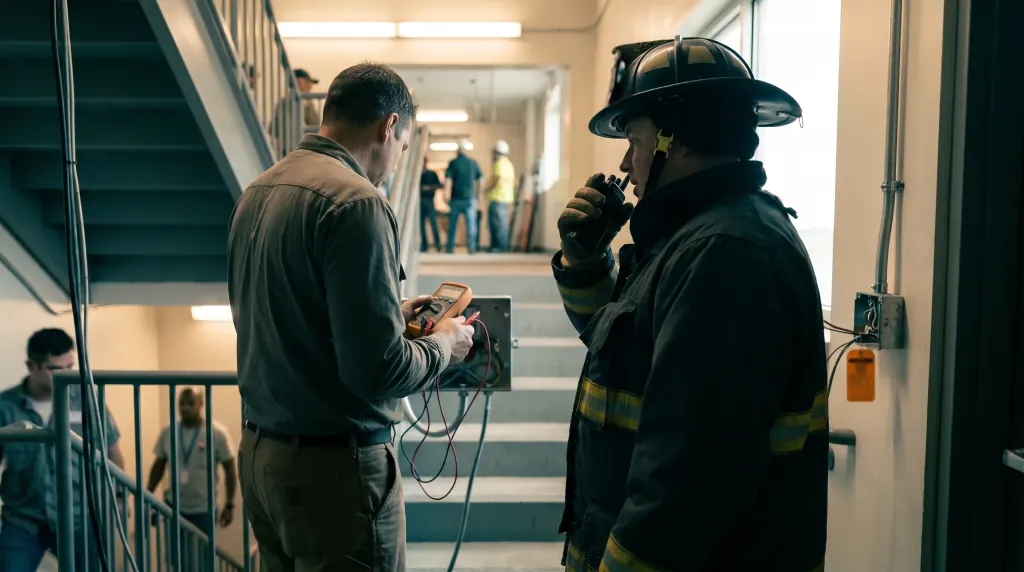
What the annual test includes
The model fire code lists four parts to the yearly test (IFC 2021 510.6.1). Ask for every one of them in the quote and in the report.
| Part of the test | What the tester does | Code reference |
|---|---|---|
| Coverage walk | Tests radio signal across a grid on every floor, 20 areas per floor | IFC 2021 510.6.1 item 1, 510.5.4 |
| Amplifier gain | Compares each amplifier's gain with the value recorded at acceptance | IFC 2021 510.6.1 item 2 |
| Battery and power | Runs batteries and power supplies under load for at least 1 hour, longer if the battery shows signs of failure | IFC 2021 510.6.1 item 3 |
| Active components | Checks every powered part against the maker's specifications | IFC 2021 510.6.1 item 4 |
| Oscillation check | Uses a spectrum analyzer to make sure the booster is not feeding back | IFC 2021 510.5.4 item 7 |
A floor passes when 95 percent of its area and 99 percent of its critical areas meet the signal level (IFC 2021 510.4.1). Critical areas include the fire command center, fire pump room, exit stairs, elevator lobbies and standpipe locations (NFPA 1225 18.8.3). For a full walk through test day, see how BDA testing works.
Who may run it
The person who runs the test must be approved by your fire marshal: NFPA 1225 says the test is "conducted, documented, and signed by a person approved by the AHJ" (NFPA 1225 20.3.10). The model code also sets credentials for the people who design and install these systems, such as an FCC general radio operator license and in-building system training, unless the fire code official accepts other proof (IFC 2021 510.5.3).
You do not have to use the company that installed the system. You do need someone your fire marshal will accept, so call the fire prevention office and ask before you book.
The paperwork the fire department wants
At the end of the test, a report that shows the system still meets the acceptance values "shall be submitted to the fire code official" (IFC 2021 510.6.1). Some fire departments take it on paper, some through an online portal, and some have their own report form. Ask yours which.
Keep these together and send copies to the tester before test day:
- The acceptance test report with the original amplifier gain values (IFC 2021 510.5.4 item 6).
- Last year's annual report, so the tester can compare.
- The radio license holder's written consent for the system, which fire marshals ask for and Florida requires for any new system or change (F.S. 633.202(18)(d)).
- A list of renovations since the last test: new walls, ceilings, roof work, new windows. These can change coverage and are a reason for testing under the code (IFC 2021 510.6.1).
Our printable inspection checklist has the full list.
Florida: what the 3 and 5 year rule covers
Florida's statute does not set the yearly test. What it does is limit how often a fire marshal can require a new assessment of a building's radio coverage: once every 3 years for high-rises and buildings over 12,000 gross square feet, once every 5 years for other buildings, with exceptions after a Level III alteration, reconstruction, or a reported radio failure (F.S. 633.202(18)(c)2).
So a Florida building with a working system still needs its yearly test under the fire code its fire marshal enforces. The 3 and 5 year limit is about coverage assessments, not about that test. The details are on our Florida re-test page, and local rules by city and county are on ERRCSCheck's requirements hub.
How to book it
- Find the due date. It is usually one year from the date on the last report or the tag on the equipment.
- Ask the fire marshal's office which code edition and report form they use, and whether they keep a list of approved testers.
- Get two or three quotes that list every part of the test above, who submits the report, and what a retest costs if something fails.
- Fix open trouble signals first. If the fire alarm panel shows a BDA trouble, have it repaired before test day. See trouble signal help.
- Plan access. Keys and an escort for stairs, roof, elevator rooms, pump room, closets, garage levels and tenant spaces. Miami-Dade, for example, requires on-site staff with access to all areas for its tests.
- Tell your monitoring company that BDA trouble signals are expected during the battery test.
What it costs
We have not found a published, verifiable price for a yearly BDA test. The price mostly follows the number of floors, the number of radio bands, and how long it takes to reach every area. Fire department fees are separate. Miami-Dade, for example, charges $194.44 when an inspection is cancelled on the day it is scheduled (Implementing Order 04-123). More on BDA costs.
If the test is overdue
Being late does not change what the test is. It does make it more urgent, because the code expects the system to be kept working at all times (IFC 2021 510.6).
- Book the earliest date a qualified tester can give you, and get it in writing.
- Call the fire marshal's office, tell them the test is late and give them the booked date. Ask if they want anything else in the meantime.
- Check the panel now. An open trouble signal means the system may already be down.
- Do not let it slide another year. Once the report is in, log the date in a free BDACheck reminder so the next one does not surprise you.
If the test finds problems, our page on what to do after a failed annual test walks through the next steps.
If you want help finding a tester, the form below sends your request to up to 3 licensed installers who serve your area. They contact you by email, or by phone only if you choose calls.
Free for owners, boards and managers
Get up to 3 quotes for the annual test
About two minutes. Tell us about the system and the deadline; testers who already work with your fire department reply.
- Your request goes to no more than 3 licensed installers or testers who work in your county.
- They write to you by email. They call only if you pick phone calls on the form.
- Nobody sends you text messages or robocalls, and your details are never sold to a list.
- Free for building owners and managers. The installers pay BDACheck for each introduction.
- No installer in your area? We say so within 2 business days and send what your local rules ask for.
BDACheck is a private company, not a government agency or fire department.
Request received
Thank you. Up to 3 licensed installers who serve your area will contact you, usually within 2 business days.
Free test reminder
Never miss the next BDA test
Add your building once and we email you before the next test is due. It is free, and setting a reminder never shares your details with an installer. Need a new system or a repair? Ask ERRCSCheck for up to 3 quotes.
Questions people ask
Is the annual BDA test really required every year?
Under the model fire code, yes: the owner must have the system "inspected and tested annually" and after structural changes that could change its performance (IFC 2021 510.6.1). NFPA 1225 asks for a documented test once every 12 months (NFPA 1225 20.3.10). Which code and edition apply to your building is set by your state and your fire marshal.
Does Florida law set the annual test date?
No. F.S. 633.202(18) does not set an annual test. Its 3 and 5 year limits apply to how often the fire marshal can require a new radio coverage assessment (F.S. 633.202(18)(c)2), not to the yearly test of a system you already have. The yearly schedule comes from the Florida Fire Prevention Code and your local fire marshal.
Can our regular fire alarm company run the test?
Only if your fire marshal accepts them. NFPA 1225 says the test must be conducted, documented and signed by a person approved by the AHJ (NFPA 1225 20.3.10). Ask the fire marshal's office whether it keeps a list or requires specific credentials, and ask the company to show theirs.
What if we cannot find the acceptance test report?
Ask the original installer for a copy first. The model code says the amplifier gain values from acceptance must be kept on file, and if they are lost the owner can be required to rerun the acceptance test (IFC 2021 510.5.4 item 6). That is a much bigger job than a yearly test.
Sources
Primary documents we read for this page. Rules change; confirm with your fire marshal (AHJ).
- International Fire Code 2021, Section 510 (text as published by the City of Eaton), City of Eaton, reproducing the ICC International Fire Code
- NFPA 1225, Standard for Emergency Services Communications, 2022 Edition: Chapter 18 and section 20.3.10, Georgia Office of Insurance and Safety Fire Commissioner (reproducing NFPA text)
- Florida Statutes 2026, section 633.202, subsection (18), The Florida Senate
- Two-Way Radio Communications Enhancement Systems: BDA Installation and Testing, Miami-Dade Fire Rescue
- General Guidelines for the Deployment of Two-Way Radio Communication Enhancement System (BDAs), Miami-Dade County Fire Prevention Division
- Implementing Order 04-123: Miami-Dade County Fire Prevention Fee Schedule (effective 10/01/2025), Miami-Dade County
Related
Something is up with your building's BDA system. Start here.
Next steps for owners and managers when the annual BDA test is due, the test failed, or the fire alarm panel shows a BDA trouble signal.
Your BDA failed its annual test. Here is the plan.
Read the deficiency list, sort repairs from upgrades, handle the permit and radio license consent, re-test and tell the fire department, step by step.
Annual BDA testing, from the building side
What happens on BDA / ERRCS test day, what the tester measures, what passes and fails under IFC 510 and NFPA 1225, and how a facilities team gets ready.
BDA inspection checklist for building managers
A printable BDA / ERRCS checklist for building managers - records to keep, a monthly look, test prep, what the tester must do and follow-up - with code references.
Free BDA test reminders
Add your building and the date of its last BDA / ERRCS test. We email you before the next one is due and keep the building's test history. Free.